Siquijor Basket Weaving and Handicrafts: A Living Tradition
Explore the traditional basket weaving and handicraft traditions of Siquijor Island. Learn about materials, techniques, artisans, and where to find authentic handmade crafts.
The Hands That Shape the Island
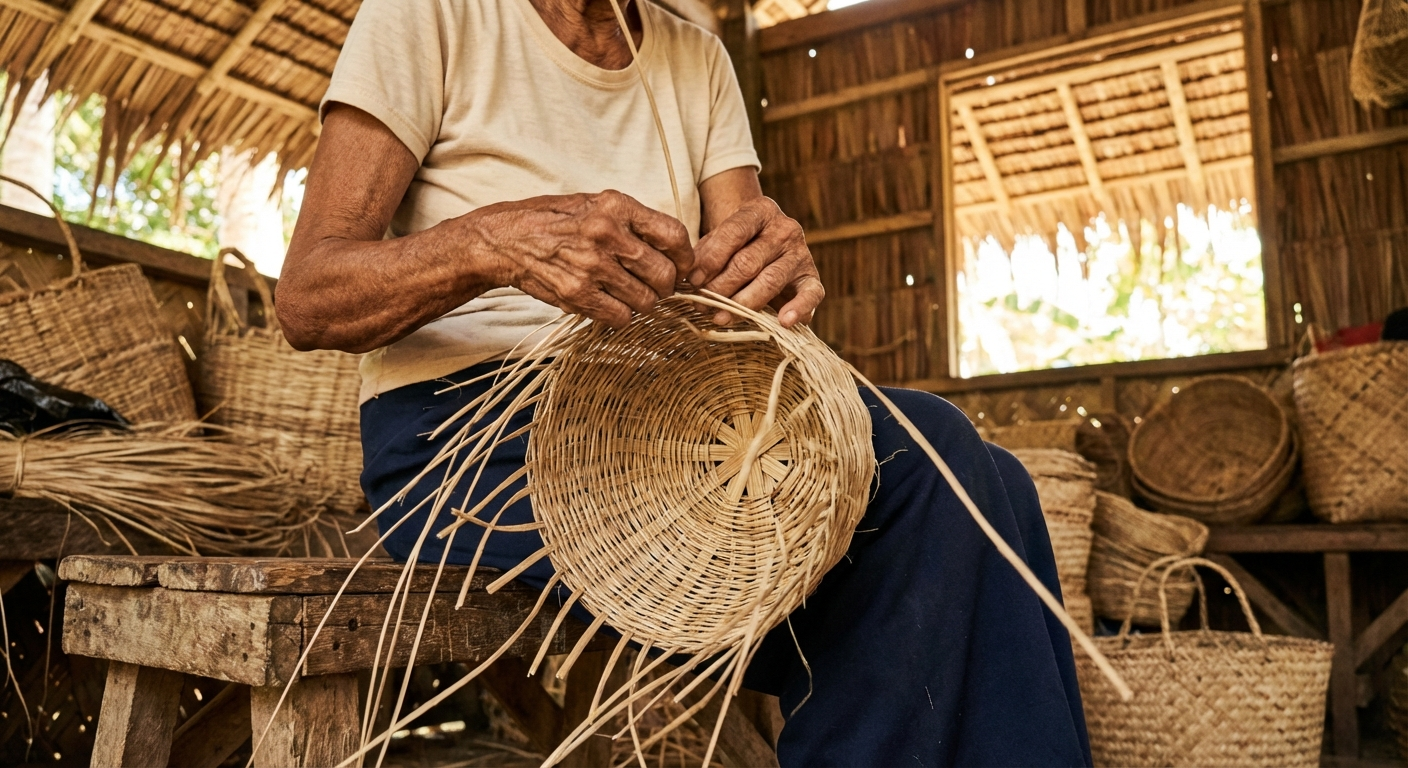
In the interior barangays of Siquijor, away from the beaches and dive shops that draw most visitors, a different kind of work continues at a pace that has not changed in generations. Women sit on wooden floors with bundles of dried leaves and strips of bamboo spread around them, their fingers moving in patterns learned from mothers and grandmothers. They are weaving baskets, mats, and containers that have served practical purposes on this island for centuries.
Basket weaving in Siquijor is not a performance for tourists. It is functional craft — the making of objects that carry harvests, store rice, filter grain, and furnish homes. That it also happens to be beautiful is almost incidental to the weavers themselves, who measure success by tightness of weave and durability of material rather than aesthetic appeal.
Understanding this tradition means understanding something fundamental about Siquijor: that the island’s culture is built on self-sufficiency and the skilled use of whatever materials the land provides.
Materials: What the Island Gives
The raw materials for Siquijor’s woven crafts come directly from the island’s vegetation. No imported fibers, no synthetic additions. Everything begins with a plant growing within walking distance of the weaver’s home.
Nipa Palm Leaves
Nipa palm grows abundantly in the low-lying coastal areas and along riverbanks throughout the island. The leaves are harvested when mature but still flexible, then dried in the sun for several days until they reach the right consistency — pliable enough to fold without cracking, but stiff enough to hold shape in a finished product.
Nipa is the most common material for large utility baskets and roofing panels. The leaves are naturally water-resistant, which makes them ideal for containers that will be exposed to rain or used to carry wet items like freshly caught fish.
Buri Palm
Buri palm produces broad, fan-shaped leaves that can be split into narrow strips for fine weaving. This is the preferred material for banig (sleeping mats), which are found in virtually every Siquijor household. The strips can be dyed using natural pigments — usually boiled bark or root extracts — to create geometric patterns in red, brown, black, and the natural cream color of the undyed fiber.
Buri grows in the drier upland areas of the island, particularly around Maria and the lower slopes of Mount Bandilaan. Harvesting is selective — only mature leaves are taken, allowing the palm to continue producing. A single buri palm can supply a weaver with material for years if harvested responsibly.
Bamboo
Several bamboo species grow on Siquijor, and the island’s craftspeople use different varieties for different purposes. Thin-walled bamboo is split into flexible strips for basket walls and decorative items. Thick-walled varieties provide structural elements — the frames and handles that give larger baskets their rigidity.
Bamboo must be treated before use. Freshly cut bamboo contains sugars that attract insects, so it is typically soaked in water for several weeks or treated with heat to remove these compounds. Some weavers smoke their bamboo strips over slow fires, which both preserves the material and gives it a distinctive amber color.
Rattan
Rattan vines grow in the forested interior of the island, climbing through the canopy of larger trees. Harvesting rattan is physically demanding work — the vines are covered in sharp thorns and must be pulled from high in the forest canopy. This difficulty makes rattan the most valued of the weaving materials, and products made primarily from rattan command higher prices.
Rattan provides both structural and decorative elements. Its natural flexibility when fresh, combined with excellent rigidity when dry, makes it suitable for furniture frames, large storage baskets, and fish traps that must withstand rough handling.
Techniques Passed Through Generations
The weaving techniques used in Siquijor are not documented in textbooks or taught in formal classes. They exist in the muscle memory of practitioners and are transmitted through direct observation and practice, typically beginning in childhood.
Basic Plaiting
The most fundamental technique is plaiting — the interlocking of strips at right angles, over-and-under, to create a flat or curved surface. Simple plaiting uses a one-over-one-under pattern, while more complex variations use two-over-two or three-over-one patterns to create visual texture.
Children learn plaiting first, usually by making simple fans or small containers. The skill looks deceptively easy when watching an experienced weaver, but beginners quickly discover that maintaining consistent tension across dozens of strips requires sustained concentration and surprisingly strong fingers.
Coiling
Coiled construction involves wrapping a core material — usually a bundle of grass or thin strips — with a binding material, building the vessel upward in a continuous spiral. This technique produces rounded forms that are difficult to achieve with plaiting alone, and it is the primary method for making cooking baskets and grain storage containers.
The strength of a coiled basket depends entirely on the tightness and consistency of the wrapping. Experienced weavers produce coils so uniform that the finished surface appears almost machined, with no visible gaps or irregularities.
Twining
Twining uses pairs of weft strands that twist around each other as they pass over and under the warp. This creates an exceptionally strong fabric that resists deformation even under heavy loads. Fish traps and agricultural carrying baskets are typically made using twining techniques because they must withstand daily use under demanding conditions.
Decorative Patterns
Advanced weavers incorporate geometric patterns into their work by manipulating the weave structure or introducing dyed strips at calculated intervals. Common motifs include diamonds, zigzags, and stepped patterns that carry specific meanings within the community. Some patterns are associated with particular families or barangays, functioning as a kind of maker’s mark that identifies the origin of the piece.
The Products
Banig (Woven Mats)
The banig is arguably the most important woven product in Siquijor daily life. These sleeping mats serve as beds, seating surfaces, drying platforms for crops, and picnic blankets. A well-made buri banig can last a decade or more with regular use and is considered an essential household item.
Full-size banig typically measure about 180 by 90 centimeters for individual sleeping mats, with larger versions made for family use. The best examples feature intricate dyed patterns and exceptionally tight weaving that creates a smooth, comfortable surface.
Prices for handmade banig vary widely based on size, material quality, and pattern complexity. Simple utilitarian mats sell for 200 to 400 PHP at local markets, while large, intricately patterned pieces can reach 1,500 to 3,000 PHP.
Bayong (Market Baskets)
The bayong is a handled carrying basket used primarily for market shopping and transporting goods. Siquijor’s version typically features a wide mouth, reinforced base, and two handles that can be carried by hand or balanced on the head — a carrying method still common among older residents, particularly women returning from market.
Bayong are made to be used hard. They carry heavy loads of produce, withstand being set down on wet surfaces, and absorb the general rough treatment of daily market use. A good bayong lasts two to three years of daily use before needing replacement.
Tiklis (Fish Traps)
Traditional fish traps made from bamboo strips represent some of the most sophisticated weaving on the island. The tiklis must be structurally sound enough to withstand ocean currents, precisely shaped to guide fish inward through a funnel opening, and durable enough to survive repeated deployment and retrieval.
The construction of tiklis is traditionally male work, one of the few areas of Siquijor weaving where gender roles are clearly defined. The knowledge of trap shapes, sizes, and placement is closely tied to fishing knowledge — understanding which trap design works for which species and in which conditions.
Decorative and Souvenir Items
In recent years, some Siquijor weavers have begun producing smaller items aimed at the tourist market. These include coasters, small baskets, woven fans, phone holders, and decorative wall pieces. While these represent a departure from the purely utilitarian tradition, they provide important income for weavers and introduce visitors to the craft.
The quality of tourist items varies considerably. The best pieces are made by the same artisans who produce functional goods, using the same materials and techniques. Less accomplished items sometimes use shortcuts — wider weaves, lower-quality materials, or incomplete finishing — that experienced buyers can identify.
Where to Find Authentic Crafts
Siquijor Public Market
The main public market in Siquijor town occasionally has woven goods for sale, particularly banig and bayong. Market days see the widest selection, as weavers from interior barangays bring their products for direct sale. Prices here are the most reasonable on the island because there is no intermediary markup.
Lazi and Maria Barangays
The inland communities of Lazi and Maria municipalities maintain the strongest weaving traditions. Visiting these areas and asking local officials about active weavers can lead to direct purchases from artisans’ homes. This approach requires more time and willingness to communicate across language differences, but it provides both the best prices and the most authentic purchasing experience.
Some barangays have informal cooperatives where several weavers pool their products for sale. These are not advertised and do not have fixed locations — asking at the barangay hall is the most reliable way to find them.
Souvenir Shops in San Juan
The tourist-oriented shops along the San Juan coastal road stock selected woven products, usually at prices 50 to 100 percent higher than market prices. The convenience and curated selection may justify the markup for visitors with limited time. Look for items with tight, consistent weaving and natural materials rather than pieces that incorporate plastic strips or synthetic dyes.
The Challenge of Continuation
Like many traditional crafts across the Philippines, basket weaving in Siquijor faces an uncertain future. The generation of women who are the island’s most skilled weavers are predominantly over 50 years old. Their daughters and granddaughters, with access to formal education and the economic pull of urban employment, are less likely to invest the years of practice needed to master the craft.
This is not a simple story of tradition versus modernity. The economics are straightforward: a skilled weaver might earn 200 to 500 PHP per day for work that is physically demanding and requires years of training. Service sector jobs in Cebu or Manila offer more for less specialized labor. The rational choice, for many young people, is to leave.
Several factors could alter this trajectory. Growing tourist interest in authentic cultural experiences creates potential for higher-value craft sales. Some craft organizations in other Philippine provinces have successfully repositioned traditional weaving as a premium product, commanding prices that make the work economically competitive. Whether Siquijor’s weaving tradition follows a similar path depends largely on whether the current generation of artisans finds support in creating that market connection.
Visiting Weavers: What to Know
If you wish to observe basket weaving during your visit to Siquijor, approach the experience with respect for both the craft and the craftspeople. These are not performers — they are workers in their homes, and their willingness to host visitors is a courtesy, not an obligation.
Ask permission before photographing. Offer to purchase something if you have taken someone’s time. A handmade basket bought directly from the weaver is both a meaningful souvenir and a direct contribution to the economic viability of the tradition.
Do not bargain aggressively. The prices asked by Siquijor weavers already reflect a craft that is severely undervalued relative to the skill and time invested. Paying the asking price — or more — is one of the most practical ways a visitor can support the continuation of this tradition.
The best time to visit weaving communities is morning, when light is good for working and temperatures have not yet reached the midday peak. Bring your own water and snacks — interior communities may not have stores nearby. A motorcycle is the most practical transport for reaching the barangays where active weavers live, as some access roads are too narrow or rough for larger vehicles.
A Craft Worth Knowing
Siquijor’s basket weaving tradition does not appear in most travel guides. It is not listed on tourism websites or promoted in hotel lobbies. It exists quietly, in the hands of people who learned it not as a marketable skill but as a basic competency for living on a small island where resources come from the land and must be shaped by human effort.
That quiet persistence is precisely what makes it valuable — both as a cultural practice and as something worth seeking out during a visit. In a world increasingly dominated by mass-produced goods, watching someone create a functional, beautiful object from raw plant materials using only their hands and inherited knowledge is a reminder of what human skill looks like when it has had generations to refine itself.
The baskets will outlast the trip. The memory of watching them being made will outlast the baskets.
Related Culture & History
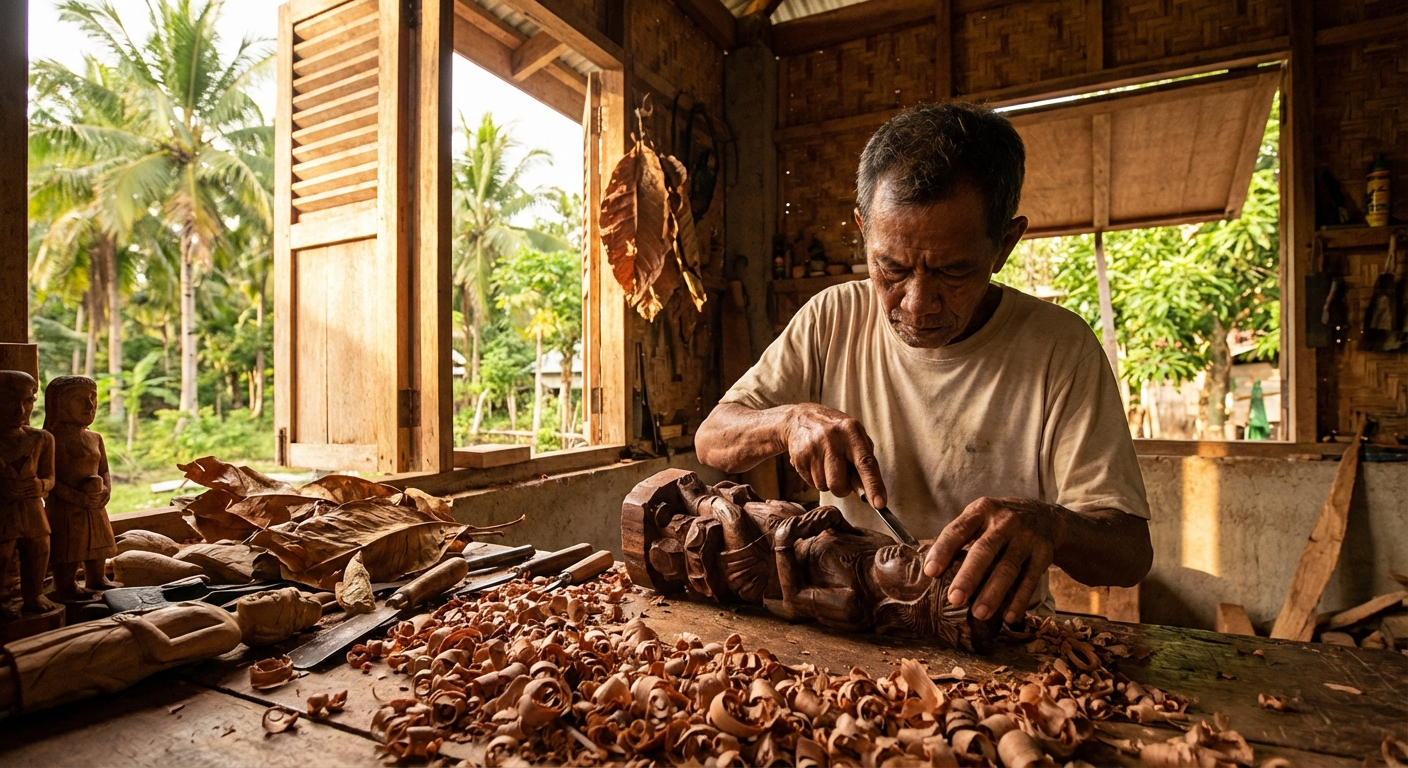
Siquijor Woodcraft and Traditional Artisans: The Island's Hidden Creative Heritage
Discover the woodcarving traditions, skilled artisans, and handcrafted souvenirs that reveal Siquijor's lesser-known creative heritage beyond its mystical reputation.
Siquijor's Mananambal: A Respectful Guide to Healing Traditions
Understanding Siquijor's traditional healers (mananambal), their practices, history, and how visitors can respectfully engage with this living cultural heritage.
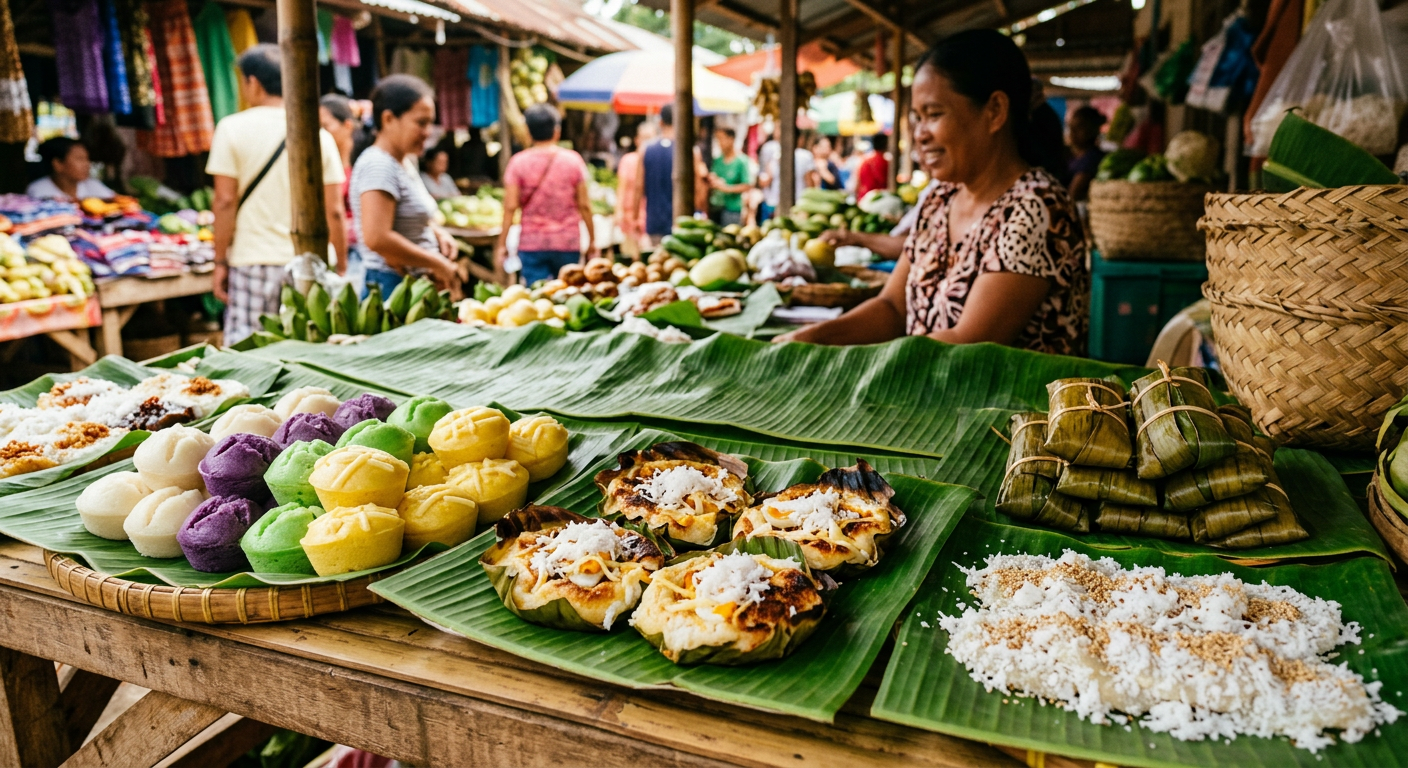
Siquijor Kakanin Guide: Traditional Rice Cakes and Sweets of the Mystic Island
Explore the traditional kakanin and rice cakes of Siquijor Island. From bibingka and suman to puto and palitaw, discover where to find authentic Filipino sweets made using generations-old recipes.