First-Timer Mistakes in Siquijor: 15 Things to Avoid on Your Trip
Avoid the most common tourist mistakes in Siquijor. From ferry booking blunders to sunscreen sins, this guide helps first-time visitors plan a smoother island experience.
Siquijor is one of the most rewarding destinations in the Philippines, but first-time visitors consistently make the same mistakes. These are not catastrophic errors that ruin a trip entirely, but they are avoidable missteps that cost time, money, or comfort. After years of watching travelers arrive on the island and learn things the hard way, we compiled this list of the fifteen most common first-timer mistakes and how to avoid every one of them.
1. Not Booking Ferry Tickets in Advance
This is the single most common mistake, and it catches travelers off guard every time. Many visitors assume they can simply show up at the Dumaguete port and board the next ferry to Siquijor. During low season, this sometimes works. During weekends, holidays, and especially Holy Week or summer months, it absolutely does not.
Ferry capacity is limited. Montenegro Lines, Maayo Shipping, and other operators run fixed schedules with fixed passenger counts. When a ferry fills, you wait for the next one, which could be two hours later or sold out as well.
The fix is straightforward. Buy your tickets a day ahead at the port, or check if online booking is available through the ferry operator’s website. If you are arriving from Cebu or Bohol, plan your connections with buffer time so a missed ferry does not cascade into a lost day.
2. Arriving Without Enough Cash
Siquijor is still largely a cash economy. While a handful of restaurants and resorts in San Juan accept GCash or credit cards, the majority of businesses on the island operate on cash only. This includes most accommodation, all tricycle drivers, entrance fees at waterfalls and sanctuaries, motorcycle rental shops, and local eateries.
There are ATMs on the island, primarily in Siquijor town and San Juan. However, these machines have withdrawal limits, occasionally run out of bills, and sometimes go offline during power interruptions. Relying solely on a single ATM visit is risky.
Withdraw enough cash in Dumaguete before boarding the ferry to cover your entire stay. A good rule of thumb is to bring your estimated daily budget plus 30 percent as a buffer. If you are staying for three days with a budget of 3,000 pesos per day, bring at least 12,000 pesos.
3. Skipping the Ecological Fee
Every visitor to Siquijor is required to pay a tourism ecological fee upon arrival. This fee, currently set at 75 pesos for domestic tourists and 200 pesos for foreign visitors, funds environmental conservation and tourism infrastructure on the island. You pay it once at the port and receive a wristband or receipt that is valid for your entire stay.
The mistake is not the fee itself, which is nominal. The mistake is losing or forgetting the receipt. Some attractions and marine sanctuaries will ask to see proof of payment. Keep your wristband on or store the receipt in your phone case or wallet where you can access it quickly.
4. Only Visiting San Juan
San Juan is the most popular municipality in Siquijor and the default base for most tourists. It has the highest concentration of accommodation, restaurants, and bars, and it sits close to major attractions like Cambugahay Falls, Paliton Beach, and several dive sites.
But Siquijor has six municipalities, and limiting yourself to San Juan means missing some of the island’s most authentic experiences. Lazi, on the southern coast, is home to the island’s most impressive church and convent, a National Cultural Treasure that few travelers bother to visit. Maria, on the eastern side, offers quiet beaches and a local fishing village atmosphere that feels decades removed from the tourist circuit. Enrique Villanueva and Larena each have their own character, attractions, and stories.
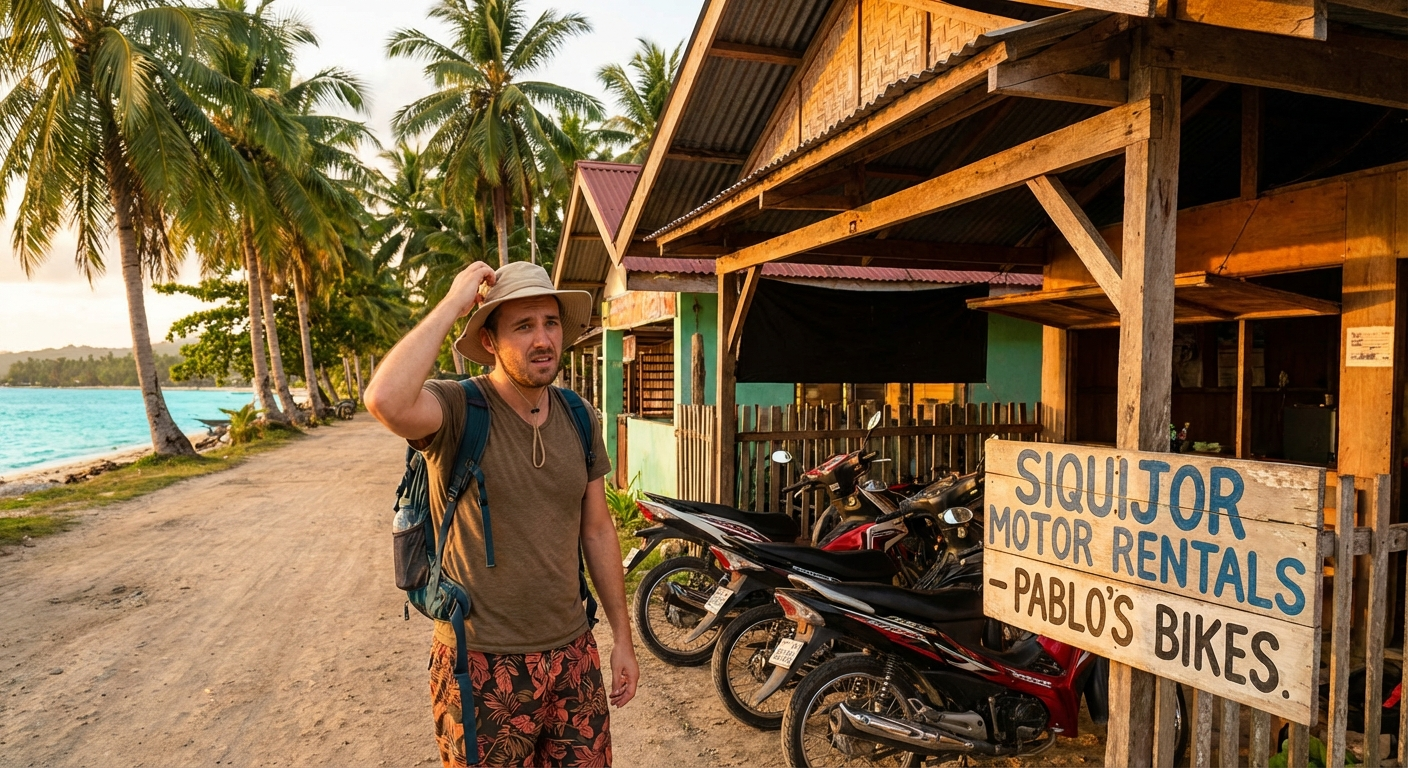
Rent a motorbike and circle the island. The full coastal loop takes three to four hours of riding without stops. With stops at beaches, churches, viewpoints, and roadside stands selling local snacks, you can easily fill an entire day and see a completely different side of Siquijor.
5. Riding a Motorcycle Without Experience
Motorbike rental is the most popular way to explore Siquijor, and for good reason. The island is small enough to circumnavigate in a few hours, the roads are scenic, and the freedom to stop anywhere is liberating. But renting a motorcycle when you have never ridden one before is a mistake that sends several tourists to the local clinic every week.
Siquijor’s roads include steep hills, tight curves, unpaved sections, loose gravel, wandering dogs, and the occasional goat standing in the middle of the road. If your only motorcycle experience is a quick scooter rental in Bali, that is not sufficient preparation for the interior mountain roads near Mount Bandilaan or the steep descent to Cambugahay Falls.
If you cannot ride confidently, hire a tricycle for the day or join a guided tour. There is no shame in choosing safety, and the views from a tricycle are just as beautiful as from a motorbike.
6. Using Non-Reef-Safe Sunscreen
Siquijor’s marine sanctuaries are among the healthiest coral reef systems in the Central Visayas. Tubod Marine Sanctuary, the Paliton reef, and the snorkeling areas around Salagdoong Beach all depend on clean water to sustain their coral and fish populations.
Conventional sunscreens containing oxybenzone and octinoxate are toxic to coral. When you swim wearing these products, the chemicals wash off and settle onto reef surfaces, contributing to coral bleaching and ecosystem damage.
Bring reef-safe, mineral-based sunscreen with zinc oxide or titanium dioxide as the active ingredients. These products sit on top of the skin rather than absorbing into it, and they do not dissolve into the water in the same harmful way. Check the label before you buy, as many sunscreens marketed as “reef-friendly” still contain problematic ingredients.
7. Underestimating the Sun
The tropical sun in Siquijor is significantly more intense than what most visitors are accustomed to, even those coming from other Southeast Asian countries. The island sits close to the equator, and UV levels are consistently high throughout the year, peaking between 10 AM and 3 PM.
First-time visitors routinely underestimate this. They spend a full morning snorkeling without reapplying sunscreen, ride a motorbike for hours with exposed shoulders, or fall asleep on the beach for thirty minutes and wake up with painful burns that affect the rest of their trip.
Wear a rash guard for water activities, reapply sunscreen every two hours, bring a hat with a wide brim, and schedule your most exposed activities for early morning or late afternoon when the sun is less direct.
8. Not Bringing a Waterproof Phone Case
Between waterfalls, snorkeling, unexpected rain showers, and boat transfers, your phone will encounter water in Siquijor. A waterproof phone case or dry bag costs a few hundred pesos and protects a device worth tens of thousands.
The most common scenario is Cambugahay Falls. Visitors jump into the turquoise pools, enjoy the rope swings, and capture photos right up until the moment their phone slips from wet hands into three meters of water. A waterproof case with a lanyard eliminates this risk entirely.
9. Disrespecting Healing Traditions
Siquijor is known as the “Mystic Island” and has a centuries-old tradition of folk healing practiced by mananambal, the island’s traditional healers. Some visitors treat this cultural heritage as a novelty or tourist attraction, approaching healers as though they are performers rather than practitioners of a living spiritual tradition.
Do not ask for “love potions” as a joke. Do not photograph healing sessions without permission. Do not mock or sensationalize what you observe. If you are genuinely interested in learning about Siquijor’s healing traditions, approach with respect, ask questions thoughtfully, and listen more than you speak.
The Enchanted Balete Tree, while a tourist attraction with a fish spa at its base, is also considered a sacred site by many locals. Treat it accordingly.
10. Trying to See Everything in One Day
Siquijor is small, roughly 340 square kilometers, and it is technically possible to circle the island and hit the major attractions in a single day. But doing so turns what should be a relaxing island experience into a rushed checklist exercise.
One-day visitors typically race from the port to Cambugahay Falls, then to Salagdoong Beach, then to the Balete Tree, and then back to the port in time for the last ferry. They see the highlights but experience nothing. They do not swim in the waterfall pools long enough to feel the cold seep into their muscles. They do not sit on Paliton Beach long enough to watch the sunset develop from orange to purple. They do not eat at a local carinderia and taste the slow-cooked chicken adobo that a grandmother has been perfecting for forty years.
Give Siquijor at least two nights. Three is better. The island reveals its character to visitors who slow down, and the best moments happen in the spaces between attractions.
11. Ignoring the Interior
Most first-time visitors stick to the coastal road and the attractions directly accessible from it. This makes geographic sense, as the circumferential road connects all six towns and passes near the majority of waterfalls and beaches. But the island’s interior, centered around Mount Bandilaan and the highland barangays, offers experiences that the coast cannot match.
The hike to Mount Bandilaan’s summit passes through old-growth forest, butterfly habitat, and medicinal plant gardens. The views from the top stretch across the entire island to the neighboring provinces of Negros Oriental, Cebu, and Bohol. The Butterfly Sanctuary near the summit provides an up-close encounter with endemic species in a setting that feels removed from the tourism circuit entirely.
Cantabon Cave, accessible from the interior road system, is one of the most authentic caving experiences in the Visayas. Unlike commercialized caves elsewhere, Cantabon is explored with a local guide, a headlamp, and your own willingness to wade through underground streams in the dark.
12. Expecting Fast WiFi Everywhere
Siquijor’s internet infrastructure has improved significantly in recent years, but it is not Cebu or Manila. WiFi in San Juan’s tourist establishments is generally functional for messaging and social media, but streaming video, uploading large files, or conducting video calls may test your patience.
Outside San Juan, connectivity drops further. If you are a digital nomad planning to work from Siquijor, identify accommodation with reliable internet before booking, and carry a local SIM card with data as a backup. Globe and Smart both have coverage on the island, though signal strength varies by location and provider.
The broader point is this: Siquijor rewards disconnection. If you can resist the urge to livestream every moment and instead be present in the experience, you will leave with better memories than any content you could have posted.
13. Forgetting to Negotiate Tricycle Fares
Tricycles in Siquijor do not use meters. Fares are based on distance, number of passengers, and an informal pricing structure that locals understand intuitively but tourists often do not. Without negotiating upfront, visitors frequently pay two to three times the standard rate.
Before getting into a tricycle, agree on the fare clearly. Ask your accommodation host what a fair price is for your intended destination. For reference, a short ride within San Juan typically costs 20 to 50 pesos per person. A ride from Siquijor town port to San Juan runs 150 to 200 pesos. A full-day tricycle tour of the island costs 1,500 to 2,500 pesos.
This is not about being cheap. It is about engaging with the local economy fairly. Overpaying by a small amount is generous. Overpaying by triple because you did not ask creates an expectation that distorts pricing for future visitors and, ultimately, for locals who use the same transportation.
14. Not Checking Ferry Schedules for Your Departure
This mistake is the mirror image of the arrival ferry problem, but it stings worse because it can cause you to miss connecting flights, buses, or onward travel plans. Visitors who carefully plan their arrival to Siquijor sometimes neglect to confirm their departure schedule until the morning they need to leave.
Ferry schedules change. Departures that existed when you arrived may not run on the day you need to leave. Weather, vessel maintenance, and demand all affect scheduling. Some routes only operate on certain days of the week.
Confirm your departure ferry schedule at least one day before you plan to leave. If possible, buy your return ticket early in your stay so your seat is guaranteed. If your onward travel involves a flight from Dumaguete, build in at least three hours of buffer time between your ferry arrival and your flight departure.
15. Leaving Without Trying Local Food
The final mistake is a culinary one. Many first-time visitors eat exclusively at tourist-oriented restaurants in San Juan, which serve decent food but do not represent what Siquijor actually tastes like. The island’s local cuisine includes dishes and preparations that you genuinely cannot find in the same form anywhere else in the Philippines.
Seek out local carinderias, the small family-run eateries that serve home-cooked Filipino food at prices that rarely exceed 80 pesos per meal. Try the fresh kinilaw (raw fish cured in vinegar and citrus), the slow-braised pork humba, and whatever fresh seafood the morning’s catch has brought in. Visit a market day and buy tropical fruits that you have never seen before, let alone tasted.
If you are visiting during a local fiesta or celebration, food is often served communally and visitors are welcomed to join. Accepting this hospitality is one of the most direct ways to connect with Siquijor’s culture beyond the beaches and waterfalls.
The One Mistake That Covers Them All
Every mistake on this list stems from the same root cause: treating Siquijor like a generic tropical destination rather than a specific place with its own rhythm, culture, and character. The island is small enough to feel familiar within a day, but deep enough to reveal new dimensions over weeks and months.
Come with respect for the place and its people. Come with flexibility in your plans. Come with enough cash, enough sunscreen, and enough time to let the island unfold at its own pace. And when you leave, you will understand why so many travelers who visit Siquijor once find themselves planning their return before they have even boarded the ferry home.
Related Travel Guides

Siquijor Pet-Friendly Travel Guide: Bringing Your Dog to the Island
Everything you need to know about traveling to Siquijor with your pet. Covers ferry rules, pet-friendly accommodations, veterinary services, beaches, and practical tips for dog owners visiting the island.

Siquijor Accessible Travel Guide: Tips for Travelers with Mobility Needs
Plan an accessible trip to Siquijor Island. Practical information on wheelchair-friendly accommodations, accessible attractions, transportation options, and tips for travelers with disabilities.
Siquijor SIM Card and Mobile Internet Guide: Staying Connected in 2026
Complete guide to getting mobile internet on Siquijor Island. Covers SIM card options, network coverage maps, data plans, WiFi hotspots, and tips for staying connected while exploring the mystic island.