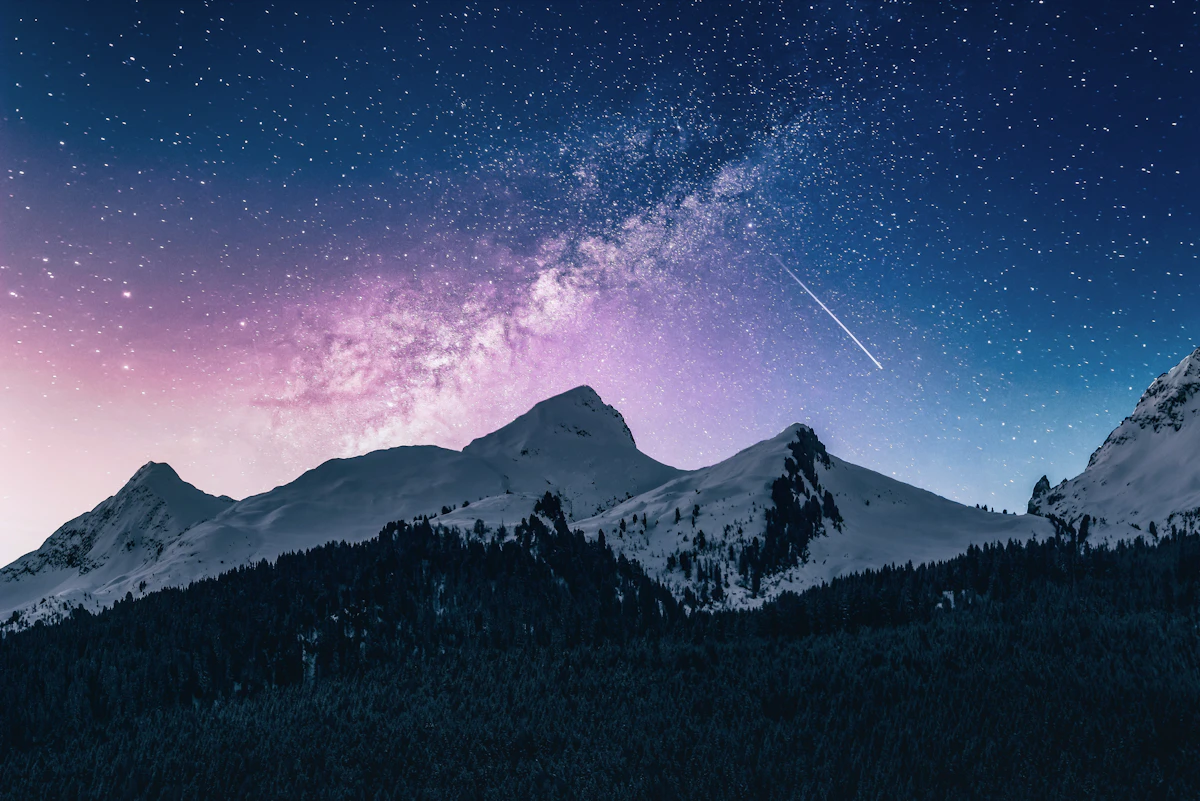
Siquijor Night Sky: Stargazing & Astronomy Guide
Discover Siquijor's best dark-sky spots for stargazing — from the Milky Way over Mount Bandilaan to bioluminescent beaches under the stars.
Why Siquijor Has Some of the Best Night Skies in the Philippines
Most travelers come to Siquijor for its beaches, waterfalls, and mystical reputation. Almost none come for the night sky — and that’s a mistake. This small island, with minimal light pollution, no major cities, and large swaths of undeveloped jungle and coastline, offers some of the darkest skies in the Central Visayas.
On a clear, moonless night from the right spot on Siquijor, you can see the Milky Way with the naked eye. Not a faint smudge — a vivid, textured band stretching from horizon to horizon, so bright it casts shadows. You can spot planets, trace constellations, watch satellites cross overhead, and if you’re lucky, catch shooting stars without even trying.
For anyone who’s spent years under city-washed skies, the experience is genuinely moving. Here’s how to make the most of it.
Best Dark-Sky Spots on Siquijor
1. Mount Bandilaan Summit (Elevation: 628m)
The best spot on the island — and possibly in the Central Visayas.
Mount Bandilaan is Siquijor’s highest point, and its summit sits above the thin layer of coastal light. On clear nights, the 360-degree view from the top delivers a sky so packed with stars it barely looks real. The Milky Way arcs directly overhead during peak months (March–September), and the lack of obstructions means you can see nearly to the horizon in every direction.
Practical details:
- Access: Drive to the Bandilaan Nature Center, then a short walk to the summit viewpoint
- Road condition: Paved but steep in sections; a scooter handles it fine
- Facilities: Basic — bring everything you need (water, snacks, blanket, flashlight)
- Safety: The road is quiet at night; bring a fully charged phone and tell someone where you’re going
- Best time: Arrive 30 minutes before full dark to set up; allow your eyes 20 minutes to adjust
Coordinates: 9.2033°N, 123.4928°E
2. Paliton Beach (West Coast)
The long, open stretch of Paliton Beach faces west and north, giving you a wide, unobstructed sky over the ocean. After sunset (Paliton is famous for those), stay for the stars. The beach is usually deserted after dark, and the sound of gentle waves adds to the atmosphere.
Why it works: No buildings, no streetlights, and the beach curves away from San Juan’s modest glow. Tip: Lie on the sand and look straight up. The contrast between the dark ocean horizon and the star-filled sky is stunning. Bring: A blanket or mat — sand gets cool at night.
Coordinates: 9.2156°N, 123.4789°E
3. Kagusuan Beach (South Coast)
This hidden cove, accessible by a steep staircase from the road, is one of the darkest spots on the island at sea level. The surrounding cliffs block any stray light, creating a natural amphitheater open to the sky.
Practical details:
- Access: Steep stairs — bring a headlamp for the descent and ascent
- Best for: Small groups or couples who want total isolation
- Note: Don’t attempt the stairs without proper lighting; the steps are uneven
Coordinates: 9.1734°N, 123.5312°E
4. Lazi Coastline (Southeast)
The stretch of coast between Lazi and Maria, particularly near the old convent, is remarkably dark. The small towns here have minimal lighting, and the coastline faces southeast — ideal for viewing the Southern Cross and the rich star fields of the southern sky.
Best viewpoint: The seawall near Lazi Church offers a stable, flat surface to set up a tripod or binoculars.
Coordinates: 9.1289°N, 123.5617°E
5. Capilay Spring Park Area (After Hours)
While the park itself closes at dusk, the surrounding area near Capilay in San Juan is surprisingly dark. The open fields around the spring give you a good chunk of unobstructed sky. Ask permission before setting up on private land — locals are generally friendly and curious about what you’re doing.
Coordinates: 9.2001°N, 123.5102°E
6. Interior Mountain Roads
The roads climbing from the coast up to Mount Bandilaan pass through dense forest and rural barangays with virtually no artificial light. Pull over at any wide spot (safely off the road), turn off your scooter’s headlight, and look up. Some of the best casual stargazing happens at these unplanned stops.
Caution: Watch for dogs, potholes, and the occasional truck. Keep a red-filtered light handy.
What You Can See
The Milky Way
Siquijor’s latitude (9°N) gives you an excellent view of the galactic center, which rises in the southeast during the best viewing months.
- Best months: March through September
- Peak visibility: April through July, when the core is highest in the sky
- Best time of night: 10:00 PM to 2:00 AM (varies by month)
- Direction: Look southeast in the evening; the core tracks across the southern sky as the night progresses
Constellations Visible from Siquijor
Being close to the equator, Siquijor has the rare advantage of seeing both northern and southern constellations:
Year-round:
- Orion (November–March, spectacular from tropical latitudes)
- Scorpius (May–September, the Milky Way’s bright center sits in Scorpius/Sagittarius)
- Southern Cross (Crux) — visible year-round but best March–June
Seasonal highlights:
- January–March: Orion dominates the evening sky; Sirius (the brightest star) blazes in the south
- April–June: The Milky Way core begins rising; Scorpius appears in the east
- July–September: Peak Milky Way season; Sagittarius and the galactic center are high overhead
- October–December: The Andromeda Galaxy (M31) is visible to the naked eye as a faint smudge in the north
Planets
At least one planet is usually visible on any given night. The brightest ones are unmistakable:
- Venus: The “evening star” or “morning star” — so bright it can cast a faint shadow. Visible in the west after sunset or east before dawn, depending on its orbit.
- Jupiter: A steady, bright point of light. With binoculars, you can see its four largest moons as tiny dots.
- Saturn: Fainter than Jupiter but still obvious. Binoculars won’t show the rings, but a small telescope will.
- Mars: Distinctly reddish. Its brightness varies dramatically depending on its distance from Earth.
Meteor Showers
Several major meteor showers are well-placed for viewing from Siquijor’s latitude:
| Shower | Peak Dates | Rate (meteors/hr) | Best Viewing |
|---|---|---|---|
| Quadrantids | Jan 3–4 | 60–120 | Pre-dawn |
| Eta Aquariids | May 5–6 | 40–60 | Pre-dawn |
| Perseids | Aug 11–13 | 60–100 | After midnight |
| Geminids | Dec 13–14 | 120–150 | All night |
The Geminids in December are arguably the best meteor shower of the year, and mid-December in Siquijor typically has clear, dry weather. Combine it with a holiday trip.
Satellites & the ISS
On any given night, you’ll likely spot 5–10 satellites crossing overhead — steady points of light moving smoothly across the sky. The International Space Station (ISS) is the brightest, sometimes outshining Venus. Check spotthestation.nasa.gov for pass times over Siquijor.
Bioluminescence Bonus
On some nights, particularly during new moon phases from May to October, the waters around Siquijor can exhibit bioluminescence — tiny organisms in the water that glow blue-green when disturbed. Imagine lying on a dark beach watching the Milky Way above while the waves glow at your feet. It doesn’t happen every night, but when it does, it’s one of the most magical natural phenomena you’ll ever witness.
When to Go Stargazing
Moon Phase Matters Most
More than weather, more than season, the moon phase determines your stargazing quality.
- New moon ± 5 days: Best conditions. The sky is at its darkest.
- Crescent moon: Acceptable, especially after the moon sets.
- Quarter moon: The Milky Way is washed out, but bright stars and planets are still visible.
- Full moon ± 5 days: Poor for stargazing. The moon illuminates the sky like a streetlight.
Plan your trip around the new moon. Check a lunar calendar before booking.
Weather Patterns
- December–May: Dry season. Higher chance of clear skies, especially January–April.
- June–November: Wet season. More cloud cover, but clear nights do happen — and when they do, the washed atmosphere can make stars even sharper.
- Best months overall: February, March, and April offer the intersection of dry weather and good Milky Way positioning.
Time of Night
- 7:00–9:00 PM: Good for planets and bright constellations. Sky is still relatively bright from twilight.
- 9:00 PM–12:00 AM: Excellent general stargazing. Most light pollution from the island dies down by 10:00 PM.
- 12:00–4:00 AM: Peak darkness. Best for the Milky Way, faint objects, and meteor showers.
- 4:00–5:30 AM: The pre-dawn sky can reveal planets and the zodiacal light — a faint, triangular glow along the ecliptic.
Gear Guide
Essential (Free)
- Your eyes: After 20 minutes of darkness, your pupils fully dilate and you can see dramatically more stars. Avoid looking at your phone screen during this adjustment period.
- Red-filtered flashlight: Red light doesn’t destroy night vision. Cover a flashlight with red cellophane, or use a headlamp with a red mode. Most phone flashlight apps have a red option.
Recommended (Budget-Friendly)
- Binoculars (₱1,500–5,000): A pair of 7x50 or 10x50 binoculars transforms stargazing. You’ll see Jupiter’s moons, the Orion Nebula, star clusters, and the texture of the Milky Way. More impactful than a cheap telescope.
- Star map app (free): Apps like Stellarium, Sky Map, or Star Walk identify anything you point your phone at. Use night mode (red screen) to preserve your dark adaptation.
- Blanket or mat: You’ll want to lie down for comfortable viewing.
- Insect repellent: Essential. Mosquitoes are active at night in Siquijor.
For Photography
- Camera with manual mode: Any camera that lets you set long exposures (15–30 seconds), wide aperture (f/2.8 or wider), and high ISO (1600–6400).
- Tripod: Non-negotiable for night photography. A lightweight travel tripod (₱1,500–4,000) works fine.
- Wide-angle lens: 14–24mm equivalent captures the most sky.
- Remote shutter or timer: Prevents camera shake during long exposures.
Basic Milky Way photo settings:
- Aperture: f/2.8 (or widest available)
- Shutter speed: 15–25 seconds (use the 500 rule: 500 ÷ focal length = max seconds)
- ISO: 3200–6400
- Focus: Manual, set to infinity. Use a bright star to fine-tune focus in live view.
- White balance: ~4000K (slightly cool, enhances the blue/purple tones)
Stargazing Etiquette & Safety
Respect the Darkness
- Don’t use white lights at shared viewing spots. A single phone screen can ruin everyone’s dark adaptation for 20 minutes.
- Ask before shining lights near others.
Safety First
- Tell someone where you’re going and when you expect to return.
- Bring a charged phone and portable battery.
- Watch your step — Siquijor’s rural areas have uneven terrain, open ditches, and roaming dogs.
- Don’t swim at night — currents can be unpredictable, and you can’t see hazards.
- Bring water and a snack — stargazing sessions can last hours.
Environmental Responsibility
- Pack out everything you bring in.
- Stay on established paths where possible.
- Keep noise down — you’re likely near homes, even if you can’t see them.
A Stargazing Itinerary
Evening Session (8:00 PM – 11:00 PM)
- 8:00 PM: Drive to Paliton Beach after dinner. Lay out a blanket and let your eyes adjust.
- 8:30 PM: Identify the brightest objects — planets first, then major constellations. Use a star app sparingly (red mode only).
- 9:00 PM: As your eyes fully adapt, notice the fainter stars filling in. The sky “deepens” noticeably over 30 minutes.
- 9:30 PM: Look for the Milky Way (if season and moon phase are right). Trace it from horizon to horizon.
- 10:00–11:00 PM: Relax and watch. You’ll see satellites, possibly a shooting star, and the slow rotation of the sky.
Deep Night Session (12:00 AM – 3:00 AM)
For serious stargazers or Milky Way photographers:
- 12:00 AM: Drive to Mount Bandilaan summit. The road is quiet but well-paved.
- 12:30 AM: Set up at the summit viewpoint. The 360-degree sky is breathtaking.
- 1:00–3:00 AM: This is peak darkness. The galactic center (if visible) is at its highest. Photograph, observe, or simply absorb the view.
- 3:00 AM: Pack up and drive down carefully. Watch for animals on the road.
Combining Stargazing with Other Activities
- Sunset to stars: Watch sunset at Paliton Beach, have dinner nearby, then return to the beach for stargazing. A perfect evening.
- Firefly spotting: Some areas near mangroves (particularly around Larena) have fireflies. Combined with a starry sky, the effect is surreal.
- Night snorkeling: A few operators offer guided night snorkel trips where you can see bioluminescent plankton and nocturnal marine life. Check with dive shops in San Juan.
- Full moon hikes: While bad for stargazing, full moon nights are perfect for moonlit hikes on Mount Bandilaan — the trail is visible without a flashlight.
Practical Information
Getting Around at Night
- Scooter rental: ₱350–400/day. Drive carefully at night — roads are unlit outside towns, and dogs sleep on the pavement.
- Tricycles are generally not available after 8:00 PM in most areas.
- If you’re not comfortable driving at night, choose a beachfront accommodation and stargaze from the shore.
What to Wear
- Light long sleeves and pants (mosquito protection)
- Closed shoes for mountain or rural locations
- A light jacket — temperatures at Mount Bandilaan’s summit can drop to 22–24°C at night
Cost
Stargazing on Siquijor is essentially free. Your only expenses are transportation and any gear you bring. This is one of the island’s best activities for budget travelers.
Final Thought
In an age where most humans have never seen a truly dark sky, Siquijor offers something increasingly precious: a direct, unfiltered view of the cosmos. No telescope required. No expensive tour. Just you, a dark beach or mountaintop, and the same stars that humans have watched for a hundred thousand years.
Look up. It’s worth it.
Related Attractions
Cambugahay Falls: Siquijor's Most Beautiful Waterfall
Complete guide to visiting Cambugahay Falls - Siquijor's crown jewel featuring three tiers of turquoise water, rope swings, and natural pools.
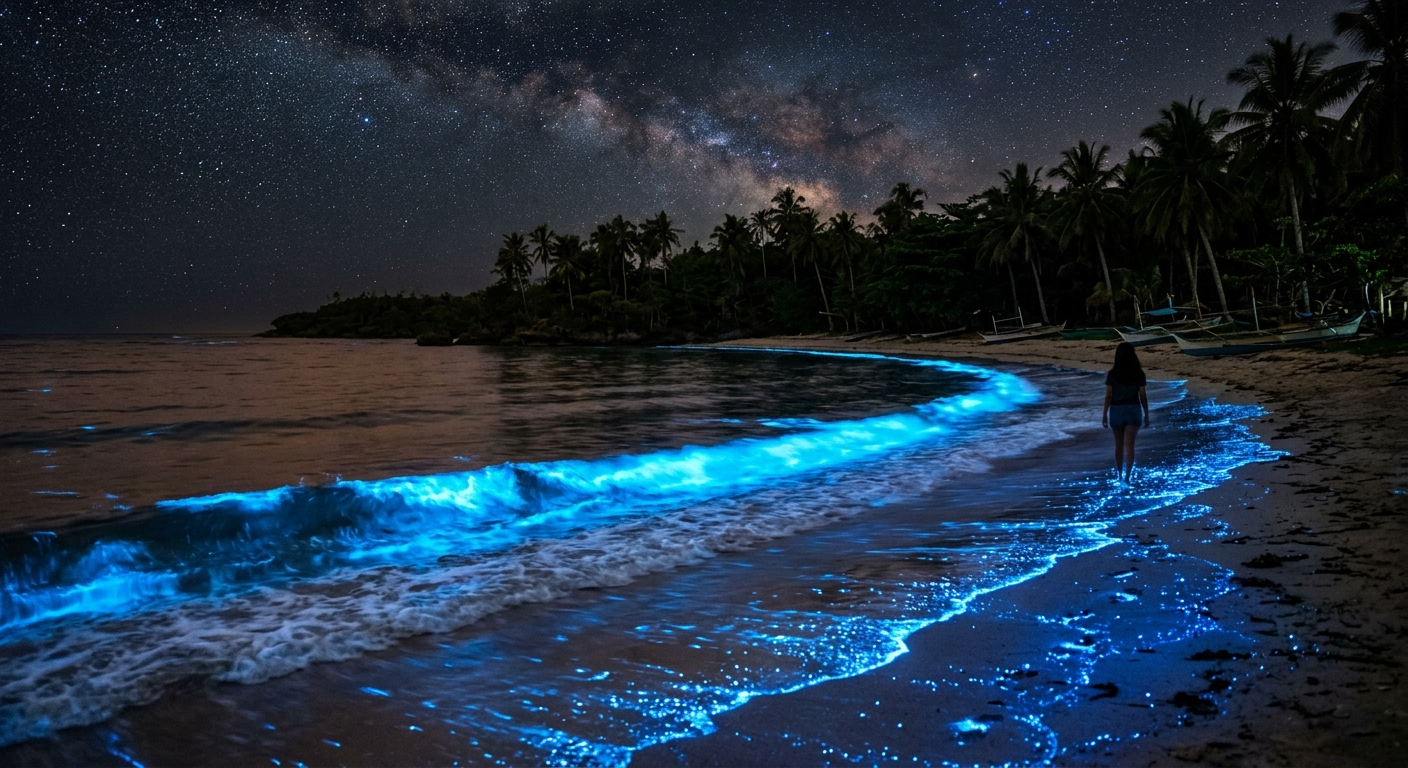
Siquijor Marine Magic: Experiencing the Bioluminescent Waters
Discover the magical bioluminescent waters of Siquijor Island. Complete guide to the glowing plankton phenomenon, best viewing spots, optimal timing, and tips for witnessing this natural light show.
Siquijor Coral Gardens: Best Snorkeling and Reef Exploration Spots
Explore Siquijor's vibrant coral gardens and top snorkeling spots from Tubod Marine Sanctuary to Paliton reef. Complete guide to underwater exploration.